
How AI in Franchise Development Is Reshaping the Way Franchisors Grow

The franchise industry is moving through 2026 with serious momentum. Franchise output is projected to exceed $920 billion this year — a 1.6% increase — and the number of franchise establishments is expected to reach 845,000 units, according to the IFA 2026 Franchising Economic Outlook. But growth at that scale doesn't come automatically. It comes from franchisors who execute smarter than their competition.
One of the clearest shifts driving that smarter execution: AI in franchise development.
The Industry Has Moved Past "Experimenting" With AI
Two years ago, AI was a novelty for most franchise brands. A chatbot here, an automated email sequence there. That's no longer where the industry sits.
The IFA 2026 Franchising Economic Outlook describes 2025 as a year when "AI adoption evolved from experimental use cases to a strategic capability embedded in core franchisor and franchisee operations." Large franchise networks integrated AI into content strategy, data infrastructure, and even organizational design — with dedicated AI leadership roles now considered as essential as traditional marketing and operations roles.
For mid-sized and emerging brands, the shift is equally significant — even if the path looks different. While large networks build in-house infrastructure, the IFA report notes that smaller and mid-sized systems are expected to rely on third-party software providers that embed AI directly into their platforms. That means franchisors can access the same capabilities without building a data science team from scratch.
Why Franchise Development Is the Highest-Value AI Use Case
AI is touching nearly every part of franchise operations. But franchise development — the process of identifying, qualifying, and converting new franchisee candidates — is where the ROI is most immediate and measurable.
The IFA report is direct on this point: "AI-powered lead qualification tools are helping score prospective franchisees, automate follow-ups, and shorten sales cycles by prioritizing viable candidates." That's not a future projection. That's what leading development teams are doing right now.
Consider the stakes. Your franchise development team has a finite amount of time. Every hour spent chasing a candidate who was never going to close is an hour not spent nurturing one who would. AI doesn't get tired, doesn't forget to follow up, and doesn't treat a lukewarm lead the same as a high-intent one. It scores, segments, and sequences — so your team works the right candidates at the right moments.
The Competitive Pressure Is Getting Steeper
Here's the context that makes franchise sales technology not just helpful, but necessary: the competitive environment for franchise recruitment is tightening.
The IFA report flags a dynamic that every franchisor should pay attention to — slowing demand combined with an expanding unit base is intensifying competition, pushing higher marketing spend at both national and local levels. You're spending more to reach candidates who have more choices than ever.
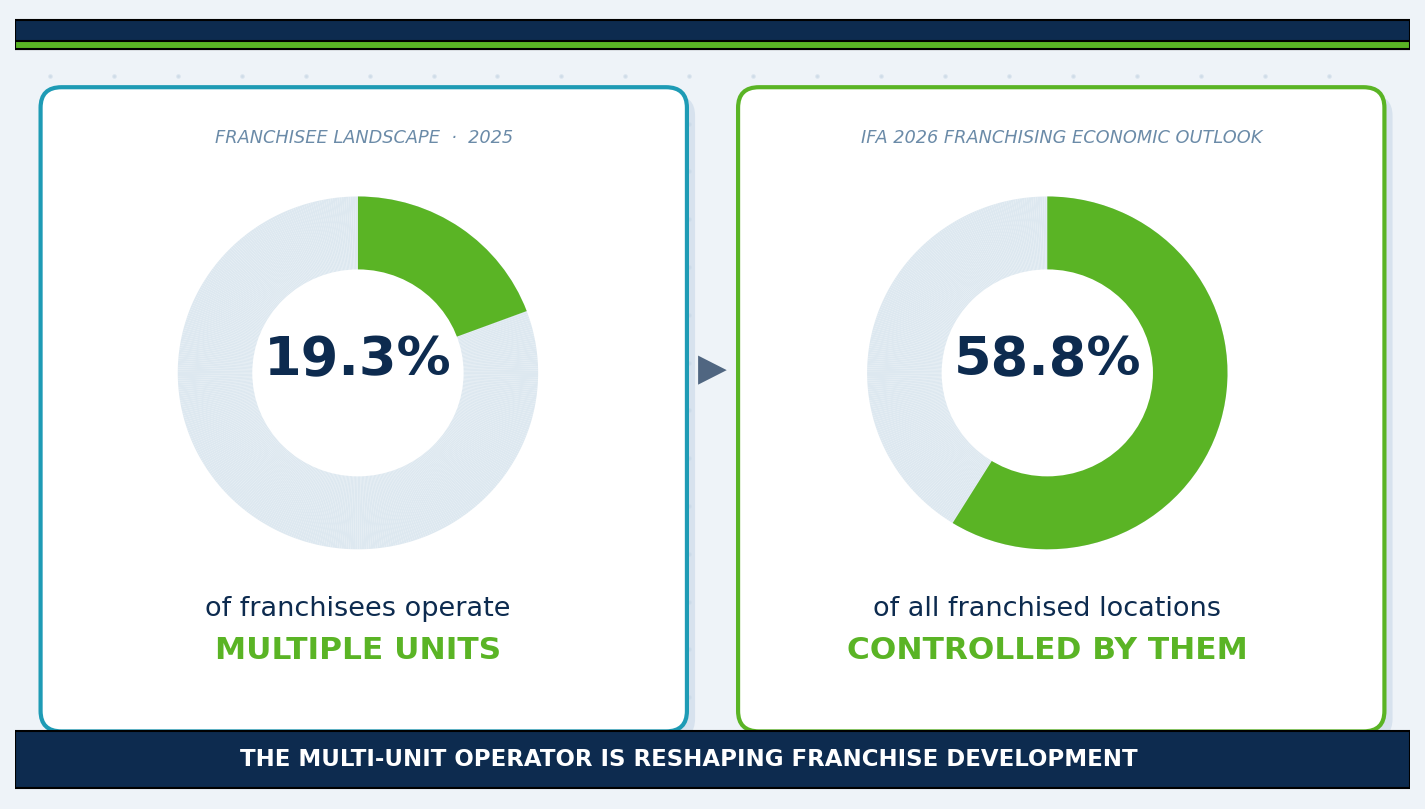
At the same time, the franchisee pool itself is evolving. Today, 19.3% of franchisees operate multiple units, and that group controls 58.8% of all franchised locations. Franchisors are increasingly expanding through existing multi-unit operators to reduce execution risk and accelerate growth — which means your development strategy needs to identify, qualify, and close a more sophisticated buyer.
That's a harder job. And it's one that AI-enabled tools are uniquely positioned to support.
What "Agentic AI" Means for Franchise Development in 2026
The IFA report introduces a term worth understanding: agentic AI. Starting in 2026, leading franchise systems are expected to move beyond traditional AI tools toward systems that "continuously interpret data, make decisions, and coordinate workflows across the franchise network."
In plain terms: AI that doesn't just respond to inputs, but proactively acts on them.
For franchise development, this matters. An agentic system doesn't just score a lead when it arrives, it:
Monitors engagement signals over time
Adjusts outreach cadence based on behavior
Flags candidates who have gone quiet
Surfaces insights to your development team before a deal falls apart
It's the difference between a tool you use and a system that works for you around the clock.
This is where franchise development software is heading — and why franchisors who invest now will have a structural advantage over those who wait.
Mid-Sized Brands Have the Most to Gain
Franchise AI investment is accelerating across the board. The IFA report points to the lodging sector's roughly 250% increase in AI investment in 2025 as a signal of what's coming industry-wide in 2026.
But the report is clear that mid-sized and emerging franchisors will invest more selectively, "prioritizing use cases with clear ROI such as labor savings, faster franchise sales cycles, and improved resource utilization." That's a disciplined, practical approach — and it's exactly the right one.
Faster franchise sales cycles are not a vague benefit; it means:
Fewer candidates go cold during a drawn-out process
Your development team closes more deals in the same period, without adding headcount
Your cost-per-close goes down while your conversion rate goes up
For a brand with 50 to 500 units that doesn't have an in-house technology team, the path to those outcomes runs directly through purpose-built franchise lead qualification tools and franchise development software designed for brands at that stage of growth.
Technology Adoption Is Now a Brand Differentiator
The IFA report makes a compelling point about why franchise brands consistently outperform independent small businesses: brand recognition, centralized marketing, purchasing scale, and — notably — franchisor support in technology adoption.
That last point matters for your development pitch, too. Prospective franchisees are evaluating your brand against others. They're asking: Does this franchisor have the infrastructure to support my success? A development process that is fast, organized, and clearly powered by modern technology sends a signal. It tells candidates that your brand invests in systems, not just in hope.
More than two-thirds of franchise brands plan to increase training and development spending, according to the 2025 IFA Annual Franchisor Survey. The brands that pair that investment with smarter development technology will see compounding returns — better candidates, faster closes, and a stronger franchise system overall.
What This Means for Your Franchise Development Strategy
The IFA 2026 Franchising Economic Outlook paints a clear picture: AI in franchise development has moved from optional to strategic. The brands that move quickly to embed AI into their lead qualification and sales processes will build advantages that are hard to replicate.
Here's what that looks like in practice:
Lead scoring that surfaces your best candidates based on actual data, not gut instinct
Automated follow-up sequences that keep candidates engaged without manual effort
Shortened sales cycles that reduce drop-off and improve conversion
Pipeline visibility that gives your team a clear view of where every candidate stands
These aren't aspirational capabilities. They're available now — through franchise development software built specifically for franchisors who want to grow without proportionally growing their overhead.
Franchise Ninja Was Built for This Moment

Franchise Ninja is a franchise development technology platform that puts these capabilities directly in the hands of franchisors. We use AI to help you:
Automate follow-ups
Shorten your sales cycle
Create website and other marketing content
Ensure website-to-FDD compliance
Monitor cold leads for renewed interest
All without requiring you to build anything in-house.
Our platform is especially valuable for mid-sized and emerging brands that need enterprise-grade development capabilities without enterprise-level complexity or cost.
The IFA's projection is clear: AI in franchise development is not a future trend. It's the current standard for brands that want to compete. Franchise Ninja helps you meet that standard.
Ready to see how it works for your brand? Request a demo and find out how Franchise Ninja can help you qualify faster, follow up smarter, and close more franchisees.
Data cited in this article is sourced from the IFA 2026 Franchising Economic Outlook, published by FRANdata on behalf of the International Franchise Association.
